






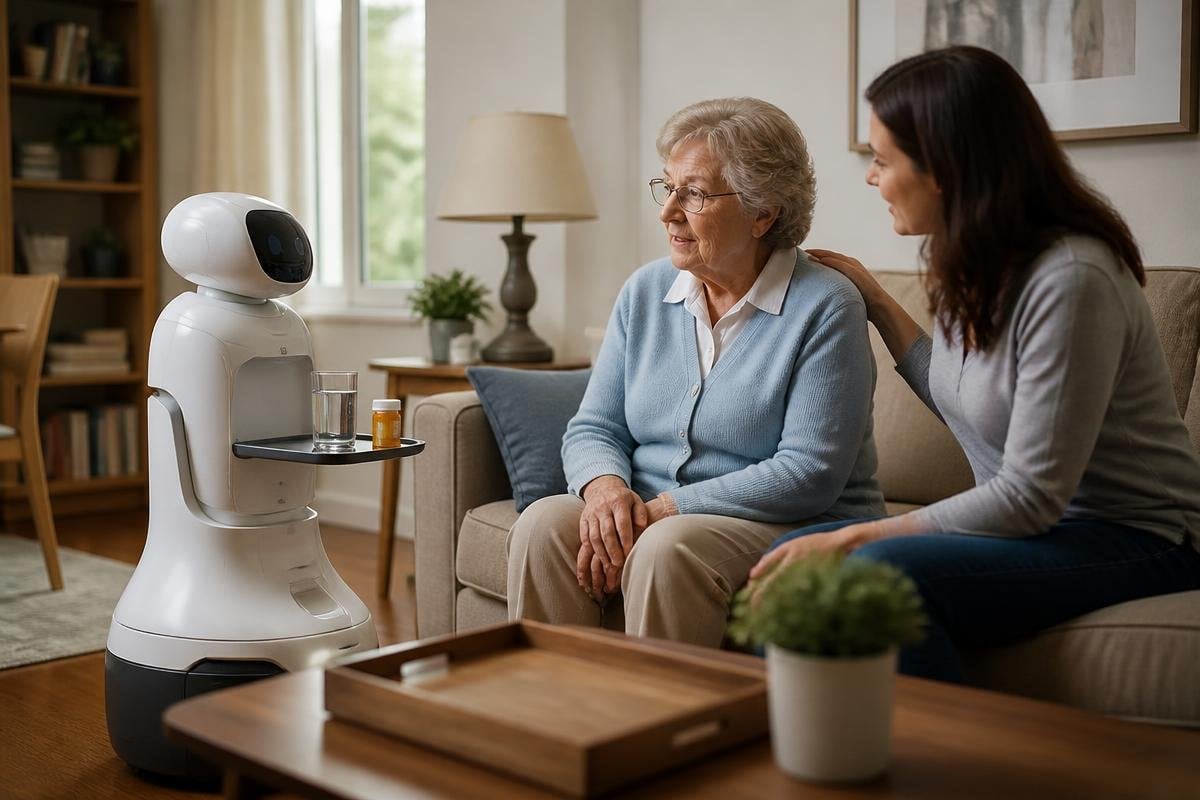
A care robot can remind someone to take medicine, call for help, or guide a person through a daily task. None of those actions answers the harder question: who notices fear, listens to a story, or stays when the plan changes?
- Robots can handle repeatable care tasks with clear rules.
- People still read tone, context, consent, and distress.
- A safe system gives control back to a person at the right moment.
Where a robot can help
Care has many small jobs. A robot can be designed to give a reminder at a set time, carry an item across a room, check whether a door is open, or connect someone with a caregiver.
These tasks have clear inputs and outputs, so a team can test whether the system did the job. That boundary matters. A reminder can be checked against a schedule, while a call for help can be checked against a set trigger.
Comfort cannot be judged by a single sensor or a successful command. The design should also state what happens when the robot is unsure. It might pause, ask the person to confirm, or contact a human.
A system that keeps acting after confusion has appeared can turn a small error into a safety problem.
Care is more than task completion
Human care includes work that has no clean success signal. A person may say they are fine while speaking more slowly, avoiding eye contact, or repeating the same concern. Those details can change what support is needed, yet they are hard to reduce to a rule.
The robot may detect a sound, movement, or spoken phrase. It still needs a safe way to handle meaning. A quiet room could mean rest, pain, privacy, or a person who wants company. The machine can’t choose correctly from sound alone.
That is why care robots should support contact with people rather than present themselves as a substitute for it. The system can remind a family member to call, bring a person into a video conversation, or give a caregiver a clear update. The human then makes the judgment that carries emotional and social weight.
A missed medication reminder can affect a person’s day, so a care-robot report should name the task, the alert, and the human response. Care robotics reports from Robot24.com can tie those details to claims about monitoring and companionship. That record shows where the robot stops and a caregiver takes over.
The control boundary
A useful care robot needs a clear handoff. The person receiving care should know when the robot is acting, what it has detected, and who can see the information. They should also have a way to stop the action without asking the robot for permission.
Consent needs the same care. A person may agree to a reminder but reject a camera. They may accept help with movement but want private conversations to stay private. Settings should reflect those choices instead of treating consent as one permanent yes.
The system should name its limits in plain language. If it cannot judge pain, say so. If a human must check an alert, say when that check will happen. A warm voice and a moving face can make a robot feel social, but they don’t prove that it understands the person in front of it.
A practical test before use
A care team can review a proposed system with these points. The answers should come from the design, not from a polished demonstration.
- Task: Name the exact job and the check that confirms it was done.
- Handoff: Name the person who receives an alert when the robot stops or becomes unsure.
- Consent: Confirm that the person can change camera, microphone, data, and contact settings.
- Failure: Describe the response to a missed reminder, blocked path, or wrong response.
- Privacy: State where the data goes, how long it stays there, and who can read it.
- Connection: Check whether the robot creates contact with people or gives others a reason to call less.
The last point carries the most weight. A robot that handles a routine task may give a caregiver more time to talk, but that result depends on how the saved time gets used.
I’d choose a care robot only when its task is clear, its limits are visible, and a person remains easy to reach. The machine can carry part of the workload; the relationship still needs someone who can listen and respond.

